
★★★★
While Wes Anderson’s recent rebuttal of a TikTok trend for style homage smacked of good will deficiency, the opening scenes of Asteroid City belie a wicked flair for the self aware. This is all very typical, Russian Doll material from the cinema’s most textbook auteur. An obdurately rectilinear repository for the whimsical, sometimes irksome and unfailingly meticulous. There’s no more emotion here than pretence. Asteroid City, we are told from the off, does not exist: ‘it is an imaginary drama created expressly for this broadcast’. Many a true word is said in jest and right back and smack a few.
Those who run in horror from Anderson’s penchant for style over dramatic substance will find themselves entirely unconverted of course. At one point here, the film’s leading man (a terrific Jason Schwartzman) very literally walks off set and out of character to enquire as to the whole point of the thing: ‘I don’t understand’. He has six minutes before his next line but receives no definite answer from Adrien Brody’s director, Schubert Green, other than vague assurance that he’s playing it right. Elsewhere, in a mockery of critical analysis, Edward Norton’s acclaimed in-film playwright, Conrad Earp, will assign meaning to an entirely spurious action by one character in his script on the back of another’s highfalutin interpretation. When the scene later plays out, it could hardly be any less meaningful.
The film exists on two stylistic levels but three planes of narrative. Bryan Cranston frames the wider whole as an unnamed host of some mid-century TV documentary. His want is to uncover the workings behind “Asteroid City,” a new play from the tortured Earp and limbering Green. Cranston’s appearances foreground enactments of the writing process, of hair and make-up, behind-the-scenes affairs and actor’s workshops. All this plays in the black and white chocolate box of Academy Ratio. Such is just one of Anderson’s wilful recalls to Hollywood’s golden age across the film. These interludes are Asteroid City’s least involving and most pretentious, almost unsettling the glory of the wider whole.
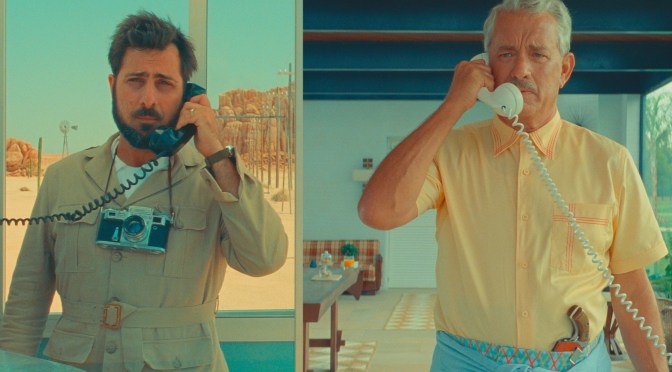
Beneath the monochrome, a more wondrous world is unwrapped. Though ostensibly staged, “Asteroid City” is a vast, tangible and Kodak saturated reality, unfurled in Wizard of Oz transitioning. These scenes, shot on location in Spain, bear striking resemblance to those vintage travel posters of yesteryear that now pepper middle class homes and chic hotel restaurants. Afforded a wider screen, Anderson lets rip here with a panopticon of zany content and delirious sight gags. There’s a road ramp that leads nowhere, a vending machine from which one can buy nearby land for little more than cents and quarters, and a wickedly unironic welcome sign for “junior stargazers and space cadets”.
The premise is a microcosmic hotbed of Andersonionisms. Precocious youngsters are gathered for Asteroid City’s annual convention of astronomical brilliance, the hamlet so named in honour of the meteorite that crashed there some 3000 years prior. One by one, bright eyed adolescents parade their deliriously advanced inventions – which include a death ray and hover pack – before a panel of scientists and militarians. Tilda Swinton plays Dr. Hickenlooper, a boggle-eyed eccentric, with Westworld’s Jeffery Wright on fast-talking fire as convention host, General Grif Gibson. Both enjoy a rib-tickling sight gag involving a pop up mic stand and brilliantly wasted Tony Revolori. Just as the pair prepare to award the top prize – an oversized cheque that is, in fact, a regularly sized cheque – a stop motion alien drops into the crater around them.
A who’s who of acting talent – old and new – stand in patient waiting for Anderson’s deliberate eye to find their frame, not one betraying a slither of emotion beneath the pitter patter of dialogue afforded them. If all cinema was like this, the multiplex might well be intolerable. A multiplex without it, however, could be no less so.

T.S.
 The Film Blog