
★★★
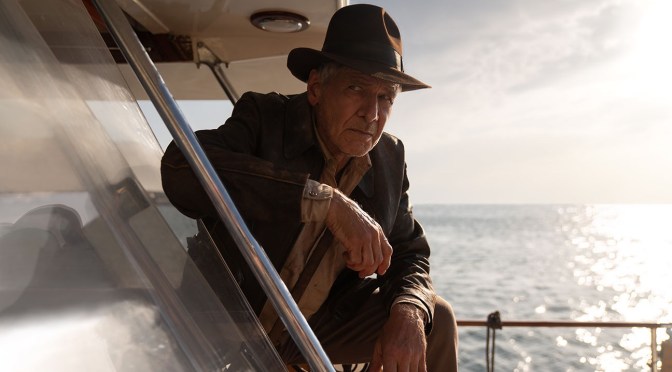
Remember that aura of dissatisfaction that haunted the multiplex as the credits rolled on 2008’s Indiana Jones and the Kingdom of the Crystal Skull? It was in the mutterings of malignancy that decried Shia LaBeouf’s irritating Mutt and ridiculed the risible extraterrestrial final act. You weren’t alone. Dial of Destiny, the fifth and final in the franchise, arrives lobbied by Harrison Ford himself and the screen icon’s personal penchant for an emotional encore. See also: The Force Awakens and Blade Runner 2049. Though seemingly unshared by Steven Spielberg, who steps back from directorial duties for the first time in the series, Ford’s passion is infectious. This one boasts some thunderously entertaining fun.
In the face of Cannes criticism, it is worth raising a brief remark in qualification. Dial brings virtually nothing new to the legend of Indiana Jones and has little of worth to add to contemporary discourse. Ford, 80, dominates, giving ‘em hell from open to close but Karen Allen, 71, merely cameos and is largely replaced by a younger model. Welshman John Rhys-Davies features as the decidedly Egyptian Sallah and there’s a whiff of unchallenged xenophobia in the film’s relationship to internationalism.
Moreover, as penned by a round table of contributors, Dial’s script plunders a greatest hits of past highs, riffing on gags and set pieces, each thirty to forty years stewed in the cultural zeitgeist. As Indy and his latest co. globetrot in hot pursuit of MacGuffin du jour, served up is perhaps the most convincing argument for AI in screenwriting to date. And yet, it works. Where Dial flies – where AI would fall – is in the loving devotion with which the rote whole is brought to exhilarating life.
Straight out of the blocks, a 1944 opening gets the boulder rolling with steam train top scrapping. Largely successful digital de-aging returns Ford to his eighties heyday in the face of a Nazi onslaught. Along with fellow archeologist Basil Shaw (Toby Jones – terrific), Jones seeks to liberate priceless artefacts from Hitler’s plunder. Among these is one half of the legendary Archimedes Dial, a clock face device with the power to transport its user in time. It’s not magic, we’re told, but maths so adds up. Besides, when your baseline is now shiny quartz skeletons with elongated heads, anything goes. In their way stands a typically dastardly Mads Mikkelsen, who plays Nazi scientist Jürgen Voller.
Flash forward a quarter century and Indy’s an old wreck, creakier than the cobwebbed tombs he once explored. His wife and son are out of the picture and retirement looms. Enter stage right, Phoebe Waller-Bridge. The Fleabag star plays sharp-witted, nimble fingered grifter Helena, Basil’s kid and Indy’s goddaughter. She too seeks the dial, albeit with financial gain atop her agenda. All they need is a pint sized pickpocket – newcomer Ethann Isidore – and fun times ahoy. And, oh boy, are they fun. A charge on horseback through the New York Subway leads to bombastic Tuk Tuk chase in Tangier and deep sea eel attack in the Aegean, with a bonkers climax too perfectly preposterous to spoil. It’s all brought to peppy life by John Williams’ – allegedly final – score. A vintage rollick down musical memory lane.
The foley too here is splendid. Each punch thrown – there are many – lands with a real thwack and there are some delightfully icky crunches. It is when revelling in the old school, rather than dabbling in dodgy green screen effects, that the film is at its best. You’d be hard pressed to call Dial of Destiny mature but there is a certain maturity to its relationship with time. Perhaps that’s to be expected from incoming director James Mangold, who has form here. It was he who, in Logan, collected the fragments of Hugh Jackman’s Wolverine for one last play in a more weather beaten toy box.
This last Indiana Jones hasn’t quite the somber undertones of Logan but in its awareness that nothing lasts forever can’t help but carry a greater weight than its more jolly predecessors. A throwaway gag about dodgy knees and a hip replacement can’t help but feel close to the metal plate. And yet, as a final lunge for the old fedora attests, pop culture never truly forgets.

T.S.
 The Film Blog