
★★★
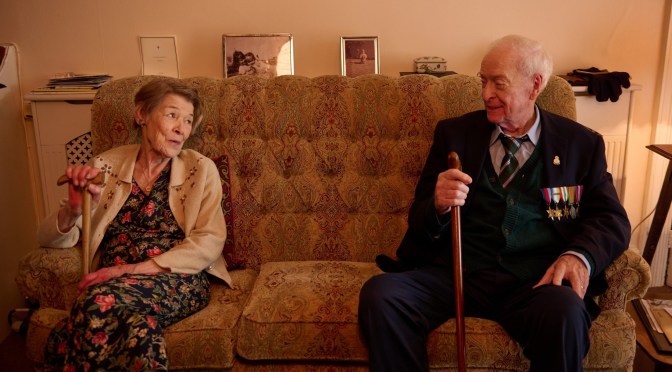
In June 2014, WWII Royal Navy veteran, tickling ninety, absconded his Hove nursing home in favour of a cross-Channel jaunt to Normandy. His want was to witness the commemoration of the D-Day landings he participated in seventy years prior and on the very beaches he once marched upon. It’s a charming tale. There’s little by way of drama – Britain was still in the EU back then – but a nation’s imagination was captured. Almost a decade on, Bernard Jordan’s adventure is immortalised in Oliver Parker’s The Great Escaper and by a rather sensational turn from Michael Caine. Having hit ninety himself this year, Caine has intimated the film may be his last. If this is to be, you’d be hard pressed to find a finer final bow from a talent so mighty.
Even if Caine is coaxed from retirement once more, Parker’s film is noteworthy for delivering the final screen appearance of the late Glenda Jackson. Hers is a role of great wit and warmth here. She plays Irene Jordan, the wife left behind in 1944 and again seventy years later. How history repeats itself. Few could bring such strength of personality and feeling to the abandoned spouse as Jackson. Certainly, Irene steals the best and most wickedly funny lines from her coast hopping husband, running riot in their bewildered nursing home.
There’s pain too and a poignance in Jackson’s own recent passing. It floods an aching awareness that nothing worth loving lasts forever. From the past, flashbacks unfold beneath a fine grain, like the proverbial sand ebbing into the lower chamber. All of this Jackson delivers in a glance. The film around her is pleasant, Sunday teatime stuff, but not half so potent.
In the face of so few obstacles, the flow here depends on Bernard’s interactions with all he meets en route. Victor Oshin’s Scott, a younger veteran of more recent conflict, proves a weaker link, engineered into the story for the benefit of a none too subtle point. More moving a presence is John Standing. He plays Arthur, a contemporary of Bernard but one who served above in the Spitfires and Hurricanes of the RAF. Though they don’t know it, each shares the other’s survivor’s guilt, past traumas only inches beneath the wrinkles of experience and passage of time. A forced and unconvincing drunken escapade with Scott says far less than the look Bernard shares with Arthur on his return from a solo wander on Sword beach. ‘How d’you get on? Ok?’ asks Arthur. Bernard doesn’t need to reply. Caine’s eyes speak, Standing’s listen.
Parker shoots the film’s beaches in a pleasing developmental trilogy, with wide, outward-gazing panoramas echoed in three gorgeous frames. There are mistakes too in Parker’s direction. A sharp withdrawal from one impassioned graveside interaction mutes the power of what could have been Caine’s most resonant dialogue. The purpose is to place him within the near five thousand graves at Bayeux but Parker fails to capture the scale and fails to value the intimacy of each soldier’s experience. Bernard is aghast on returning home to a flood of paparazzi. This was his journey to make and his alone. Ours is not to question why.
In that, there’s something rather hypocritical in the film’s approach to Bernard’s burgeoning celebrity. Certainly, an excess of sentimentality occasionally overstates the wonderment of his journey as some form of patriotic exhibition. And yet, between then, Caine and Jackson elicit something really rather special. It’s performative magic and extraordinarily life affirming to witness.

T.S.
 The Film Blog