
★★★
Two decades of narrative reclamation haven’t been kind to Mean Girls. That’s not to withdraw the film’s status as the noughties’ seminal behemoth. The film remains the most instantly quotable of the twenty-first century to date. It’s fetch. And yet, as astute as Mean Girls was in its acerbic assessment of clique culture, the aging process has exposed through lines of misogyny, racism and homophobia. To this end, the 2024 do-over can’t help but feel like contemporary sanitisation. The product of a late night spent pouring over think piece assassinations. It’s fun. It’s well cast. It still doesn’t make fetch happen.
Following the trend of Hairspray and The Producers, Mean Girls mark two is actually third in the franchise, an adaptation of the Broadway musical spun from the original. Tina Fey is back on writing duties, penning updated gags around toe tapping numbers from Jeff Richmond and Nell Benjamin. Curiously, the film’s musical credentials have been largely shielded from promotional material. An odd call. Alongside its casting, the songs mark the film’s strongest suit, serving in the stead of Lindsey Lohan’s original narration and upping the camp tenfold. It’s in musical asides – often played unapologetically to camera – like ‘What’s Wrong With Me?’ and ‘Sexy’ that previously minor parts enjoy expansion and gain humanity.
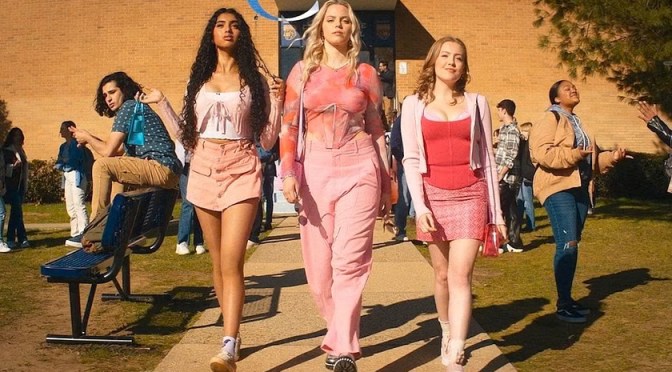
Reparative cuts aside, Fey’s script is largely identikit. Marvel youngster Angourie Rice plays Cady Heron, an ingenue homeschooler, raised in Kenya and unprepared for her high school debut on returning to the States. Dual directors Arturo Perez Jr. and Samantha Jayne handle the safari connotations rather more deftly than once did Mark Walters but revel in a fierce reprise for the story’s apex predator, Regina George. Having owned the role on Broadway, Reneé Rapp nails her feature debut as cinema’s ultimate queen bee. There’s not a scene here Rapp doesn’t steal, with her sultry pop vocals and effortless confidence oozing from the film’s oft shifting aspect ratio. Avantika and Bebe Wood prove strong too as fellow plastics Karen and Gretchen.
Spurred on by jaded outsiders Janis (Moana voice Auliʻi Cravalho) and Damian (Jaquel Spivey), Cady infiltrates Regina’s inner circle with sabotage in mind. Much has changed in twenty years and to the infectious repugnance of popularity Fey inflicts an awareness for the changed relationship of today’s youth with fame. The iPhone did not exist in 2004 and social media remained a Harvard exclusive, courtesy of a young Mark Zuckerberg. It’s easier than ever to rise and easier still to fall. TikTok reels and hearts pepper the film, reminiscent of similar stylisations in the recent Dear Evan Hansen film.
There’s an interest too here in the ever shifting dynamics of youthspeak and an increasingly pernicious attitude to self-perseveration in certain quarters. At one point in the film, Regina weaponises ‘unresolved trauma’, while elsewhere Cady is accused of ‘slut shaming’ for the crime of…not dressing slutty at a Halloween party.
It’s in these diversions from the original that Mean Girls 3.0 comes closest to greatness. And yet, Fey too often retreads old highlights, too many scenes played in verbatim. A failure to include ‘it’s October 3rd’ or ‘you go Glen Coco’ would, of course, have been sacrilege, but did we need a word-for-word recreation of Ms. Norbury’s (Fey) cathartic intervention in the final act? Such moments do more to remove viewers from the narrative than those scenes in which characters burst into song down the barrel of the fourth wall. It doesn’t help that the film feels so obviously televisual. Only late last year did Paramount upgrade Mean Girls from streaming to wide release. Too late to up the budget or cinematic ambition.
Really, it’s only in the final bow that the film is able to step away from self-imposed tribute act limitations. Cravalho aces a banger about giving the world your middle finger and a delicious cameo electrifies the mathelete finals. New converts are unlikely but fans will squeal. Get in losers.

T.S.
 The Film Blog