
★★★★
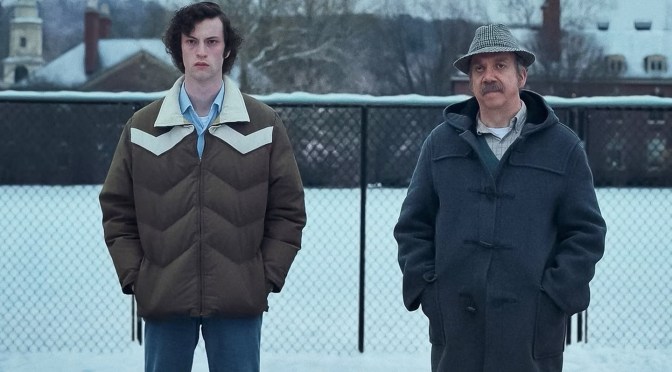
There’s a scene in The Holdovers in which Paul Giamatti’s cantankerous classics teacher, Mr. Hunham, hobbles out on Christmas morning to buy a tree. It’s a last minute plug to reintroduce festivity unto the emptied out halls of his workplace, the Barton Academy boarding school. Such proves a melancholy sight. A shonky spruce, sparsely decorated, and tilting tiredly to the right. And yet, it’s a gesture of hope too. An image of merriment. In many ways, this weary symbol of seasonal fancy embodies The Holdovers, which ambles into cinemas several weeks late for Christmas. The film reminds of joyful days past, even as a long, bleak winter sets in. Nailed is that happy-sad sweet spot all too often felt in the so-called most wonderful season of all.
The film reunites Giamatti with writer-director Alexander Payne, twenty long years after their first and last collaboration. It makes sense, of course, that Payne thought first of Giamatti for The Holdovers. In Sideways, too, the star played a depressed teacher with authorial aspirations and well worried liver. The film shares also, in spite of a largely hermetic setting, Payne’s penchant for road trip relationships, building on the intergenerational themes of Nebraska and The Descendants. Giamatti is perfect for the part, all world weary cynicism and wayside dreams. There’s something oddly endearing about his embittered Hunham. Certainly, his objections to the nepotistic world around him carry something of a contemporary relatability.
As penned by David Hemingson, in his feature debut, The Holdovers takes inspiration from Marcel Pagnol’s 1935 French comic drama Merlusse. The year is 1970. With the Christmas holidays fast approaching, all but five of the Barton Academy boys are heading off to well heated homes and rich parents. Entitlement drips from the silver spoons within each mouth. The quintet left behind stay so under Hunham’s watchful – albeit lazy – eye. He drew the short straw, having upset headteacher Dr. Woodrup (Andrew Garman) by failing the feckless son of an important donor. The prestige is political here.
Fortune favours four, however, whisking them off for an Alpine ski trip. This leaves only the sharp witted but despondent Angus Tully (Dominic Sessa) with Hunham. He’s an intelligent reprobate, loaded with promise, but only externally abrasive. There’s a soft and wounded soul within. The reveal is heartbreaking. Da’Vine Joy Randolph’s on site too. She plays head cook Mary, a freshly grieving mother, having lost her son to the war in Vietnam. Such is a looming weight in absentia. There’s no chance of a true blue Barton boy being sent to ‘nam.
It’s with astonishing commitment to period detail that Payne evokes the film’s seventies backdrop. Era evocation pervades not just set dressing, hair and costume but every inch of Eigil Bryld’s exquisitely grained cinematography. The film even boasts a vintage certification of BBFC approval ahead of the titles. Cat Stevens, Labi Siffre and the Chambers Brothers dominate a soulful soundtrack, which is peppered too with Christmas carols and, of course, Andy Williams. Snow flurries before the action, with a thick blanket of the white stuff burying the ground. Suddenly, Hunham’s contained existence feels as akin to a snow globe, all ready for the shaking.
This is sympathetic, human storytelling. Giamatti and Sessa delight in the delivery their beautifully elliptical arcs, with Randolph an emotive revelation. Early on, Hunham is compelled to ‘at least pretend to be a human being’. He’s complex, hurting and holding out for someone to remind him of the hope that Christmas can bring. What’s more human than that? Lovely.

T.S.
 The Film Blog