
★★★★
A knot loops itself into formation early on in Speak No Evil, James Watkins’ Devon set remake of the 2022 Danish original by Christian Tafdrup. It’s a simple tie, a mere clove hitch, and hidden beneath a veil of geniality. Sure enough, the film’s first thirty minutes or so are genuinely very funny. Knowing, witty and surprisingly scatological. And yet, as things progress, as the peril rises and hints of shade give way to a staggering pit of darkness, the knot tightens. All too late, it’s got you. The loop opens up and in you fall. It’s no longer a clove hitch. It’s a hangman’s knot.
Watkins’ take is a touch more palatable than was Tafdrup’s. Retained is the gnawing social satire, softened is the nihilistic inclinations. Where there was ne’re a sympathetic soul in the original nasty, the hammer of judgement falls with a mite more clarity. Such is always the way, no? Yet, Watkins’ film does, at least, boast a certain distinctiveness, the translation proving as effective in the new language as old. There’s even something of the English folk tradition folded into the narrative’s ready baked horror, a heritage befitting of the lush, rolling landscape it now rises within. It’s in the Danny Bensi and Saunder Jurriaans scored soundscape, the outsiderism, and the malevolence of a decidedly wicked late reveal.
Easing into darkness, the film opens to warmer climbs. Mackenzie Davis and Scoot McNairy play Louise and Ben Dalton, an American couple holidaying with their young daughter – Alix West Lefler’s Agnes – in a sun-kissed Italy. Already, a slight awkwardness pervades. There’s tension between Ben and Louise, while, an otherwise sound, Agnes cascades into distress whenever separated from her beloved comfort bunny. In Italy, the Dalton’s meet Paddy and Ciara, a British couple, eased into life by James McAvoy and Aisling Franciosi. She’s gently charming, he’s forcefully funny. Their son – Dan Hough’s Ant – hasn’t a say in the matter. He has no tongue and can, very literally, speak no evil. Hough, a newcomer, is terrific.
Bonded by locale, and the commune of horror that is shared time among awful people, the two families connect. Paddy’s offer of a sequel break in Devon, though met with noncommittal smiles on offering, proves hard to resist when a return to dreary London revitalises old wounds. And so that’s what they do. Only, one should never run away from one’s problems. Certainly, this feels a poor recourse when said problems prove all too able to survive the journey south-west. To this end, Ben’s unemployment and Louise’s infidelity are easy targets in a household dynamic rather more aggressively probing than the hay bales and homemade liquor suggest.
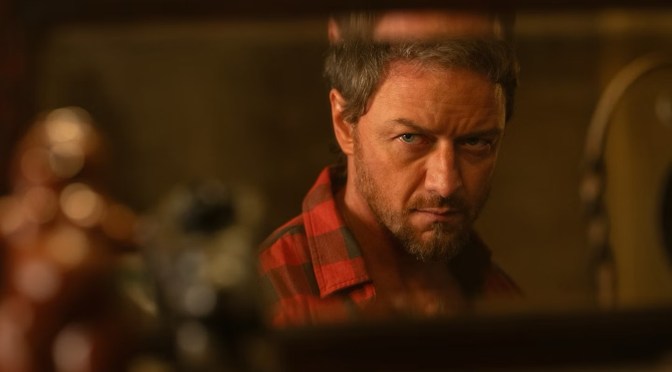
Key to the horror experience of Speak No Evil is an understanding of the societal norms that allow the events to unfold. At any point in the film, certainly in the first half, Louise and Dan could re-write their narrative. They could say no to Paddy’s unreasonable demands, just as they could call out his increasingly un-passive aggressions. The signs are all there. McAvoy is, to this end, alarmingly effective. Once a Hollywood heartthrob, the Scot wields his earthy charms with unsettling acuity. It’s a stunning performance – tour de force in execution – and proves vital to the film’s ability to plough its own against an already acclaimed original. His Paddy is charm personified, evil epitomised and the stuff of nightmares.
As the final act looms, nuance falls victim to a fiercer pace. A wordy, somewhat redundant, vocalisation of events and themes only briefly interrupts a gallop towards a finish line that feels pleasingly unpredictable. Having built his horror on tenements of tension and of social anxiety, Watkins punctures the palpability in a deft swoop. It’s a nice finish. Nice, but nasty.

T.S.
 The Film Blog