
★★★
There’s little in Wicked, Jon M. Chu’s unjustifiably long adaptation of the eponymous musical’s first act, likely to convert the unconverted. It’s a fitfully spellbinding affair but not quite transformationally bewitching. Those who love Wicked, will embrace the film in kind. It boasts excellent performances, extravagant set pieces and frankly extraordinary attention to detail. Those who do not, take heed: in spite of a runtime almost as long as the entire Broadway show, intermission included, Chu’s Wicked only manages to reach the show’s infamous half-time banger, “Defying Gravity”, by the roll of its credits. Part Two is twelve months from release. It’s a Jacksonian split either agonising or frustrating, dependent on personal inclination. Both, really.
As something of a twice-viewed agnostic, both of the show and its success, the flimsy politics and semi-forgettable tunes – only a couple truly fly outwit the theatre – lean me generally toward the latter camp. That’s my bias. When it comes to the film, an hour of superfluous padding cannot possibly resolve the core plot failings. Animal activism is, no doubt, a worthy thoroughfare. Its use as a tool to critique populism, meanwhile, will prove particularly resonant to a late 2024 audience.
And yet, Wicked’s execution is blunt and the handling of unconvincing character arcs muddled. Such has not, of course, perturbed the legions of fans who have propelled Wicked from Broadway to global sensation. The musical is second only to Disney’s Lion King in the all time rankings. A film adaptation has long felt inevitable.
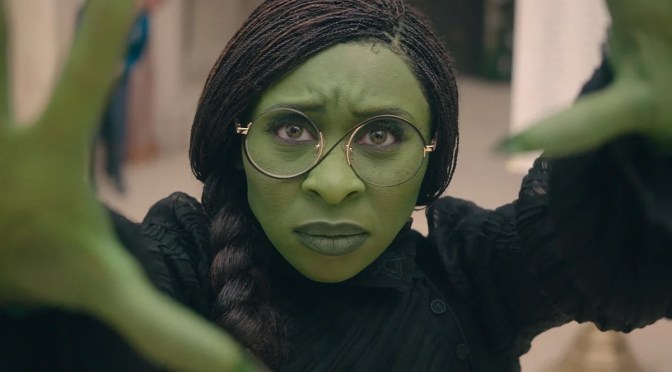
The story, drawn from Gregory Maguire’s original 1995 novel, rewrites L. Frank Baum’s The Wizard of Oz through the prism perspective of the witches of Oz. Cynthia Erivo plays Elphaba, Baum’s Wicked Witch of the West and Maguire’s tragic heroine. She’s tremendous and burns with the pain of long suppressed hurt. Pop-megastar Ariana Grande is fine enough Glinda – initially known as Galinda – the golden girl of Oz, reimagined as magically castrated and comically conceited. The two meet at the prestigious Shiz University, early enmity evolving into sincere friendship on their learning that each has much to learn from the other. Fellow students include Ethan Slater’s Boq, who yearns for Glinda’s attention, and Jonathan Bailey’s dashingly metrosexual Fiyero, who can’t get away from it.
Elphaba’s magical prowess is obvious but so is the singularity of her pea green skin. Flashbacks to a troubled childhood forebode the bullying Elphaba will experience at Shiz and the ostracism she will ultimately face when outcast as the so-called Wicked Witch. Handpicked, however, by school sorceress supreme, Madame Morrible (Michelle Yeoh), Elphaba soon finds herself invited to meet the Wonderful Wizard himself (Jeff Goldblum doing Jeff Goldblum).
All is not so peachy as it seems. The animal folk of Oz are being scapegoated, silenced and caged – no prizes for guessing who by. It’s a similar plot to the more recent Zootropolis but with a touch less impact. Peter Dinklage delivers a nice turn as goat historian Dr Dillamond but insufficient attention is paid to actively making audiences care about the fate of any other talking animal.
More time is gifted the film’s many musical numbers. It is in these sequences that Wicked really comes to life. Chu has form on exquisite musical direction, having delivered 2021’s criminally underrated In the Heights, and nails the same exuberance here. It’s exhilarating stuff and meticulously executed. Still, there are niggles here too, not least in the film’s aggrandised sense of self-importance. This felt not just in the elongated length but in Wicked’s severe and severely maudlin approach to colouration, light and grading, the desaturation of which proves ill-befitting to its vibrant choreography and costumes.
Only occasionally are Galinda’s pinks and Elphaba’s greens permitted to truly pop, and only when they are able to overcome Chu’s unaesthetic interest in backlighting. The conclusion of Grande’s “Popular” routine sees the star bathed in a rush of fabulous pink. It’s a rare hint of the camp might have been.
Indeed, lacking is an engagement with the fantastical side of Oz. The technicolour wonderment that widened Judy Garland’s eyes. Even as a stream of superfluous suffixes lodge themselves upon the end of character dialogifies, these occur a little like a Mike Leigh directed take on Dr. Seuss. From here, a more dour second half awaits, for better or worse. With fewer opportunities for fun in part two, it’s hard not to fear the drag ahead. Only when the two are whole, however, can success truly be judged. A long wait for a dedicated fan, then. I’m just not sure I’m that guy.

T.S.
 The Film Blog