
★★
It’s amazing just how involving The Lion King is on stage. The lack of actual, or, indeed, believable, lions on stage matters less in this context than the ability of the actors to speak to the emotional truth of the characters they are playing. Through the abstracted masks and feathers, the circle of life lives. There’s a joke on this matter in the latter half of Mufasa, Disney’s financially viable follow up to Jon Favreau’s 2019 photoreal remake of the original 1994 Lion King. A Billy Eichner voiced Timon snarks his distaste for the show on the basis of his part being played by a sock puppet. That’s the joke. To this there is only one response. Mufasa’s Timon may look exactly the part of the meerkat he is but he hasn’t half the warmth, humour and soul of the sock.
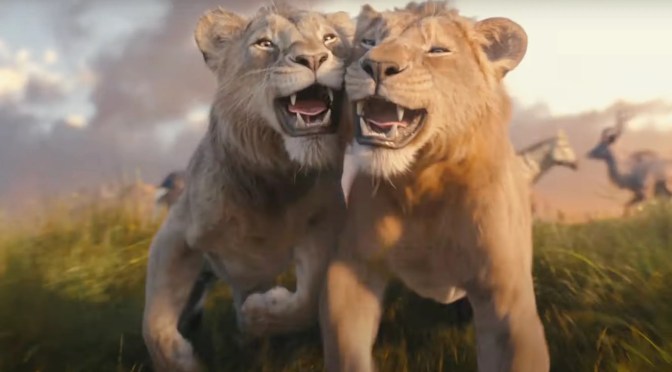
Where theatre’s Lion King absorbs from open to close, cinema’s Mufasa is but a fitfully involving affair. Pleasing enough for a couple of hours, without ever going so far as to actively astonish or move. As directed by Moonlight and Beale Street’s Barry Jenkins, usually so intuitive in grounding his characters’ emotions, there’s no doubting the visual attractiveness of the film. Technically, it’s brilliant. A triumph of computer generated artistry, masterfully drawn and a testament to technological advancement. You’ll believe a lion can sing – for a moment, at least. Certainly, they do so with rather more physiognomic versatility than was the case in Favreau’s original. There’s less of the taxidermic here.
There are other ways in which the film’s animation improves upon its predecessor too. It’s not simply the detailed rendering of each hair and vista that impresses but the weight and gravity of it all. When the lions fight, they do so with dense and malleable muscles, hitting a ground without give. Jenkins’ excessive use of foreshortened facial close ups jars but when his lens retreats, when the anthropomorphism loses the foreground, the visuals dazzle. You can all but reach out and run your fingers through the texture on display across a screen that boasts not a second of actual live action footage. It’s a world made for the VR experience.
Away from the techs and specs, the story itself plays largely by default. Opening some years on from the close of The Lion King, Mufasa finds the child of Simba (Donald Glover) and Nala (Beyoncé) left in the care of Timon, Pumba (Seth Rogen) and Rafiki (John Kani). As storm clouds grow over Pride Rock, Rafiki comforts the nervous cub with stories of her grandfather and the origins of the enmity he shared with his brother, Scar. Only, as we retreat into flashback, it transpires that Mufasa and Scar were never actually brothers. It’s a rather depressing launchpad that sees Mufasa separated from his parents within the film’s first ten minutes, washed far down river and ultimately rescued by his future murderer, who is here named Taka. It’s hard to imagine many going wild for such detail. Few asked for a pseudo live action Lion King to start with, never mind a sequel for it.
When Taka’s family fall prey to a pride of white lions, lead by Mads Mikkelsen’s genuinely unnerving Kiros, he and Mufasa must seek out sanctuary in the mythical Milele. More familiar faces join the odyssey as they go, while frustrating and desperately unfunny interludes in the present interrupt the flow periodically. Much as Nathan Lane and Ernie Sabella were genuinely hilarious in the original animation, Rogen and Eichner missed the mark in their first try and the embarrass in their second. They aside – or inclusive – Mufasa is a largely humourless effort, with a forgettable soundtrack from an out-of-his-depth Lin Manuel Miranda compounding the issue. Only one song in the film – the rousing ‘I Always Wanted a Brother’ – comes close to bonafide entertainment.
As for Jenkins, one suspects this will be his last foray into studio filmmaking. Hints at thematic overlay with his interests – namely masculinity, friendship and orphanage as a rite of passage – hum through Mufasa but without his usual depth of engagement. Stripped away is Jenkins’ penchant for intimate filmmaking and the sort of ambition that propelled The Lion King brand from hit toon to global phenomenon.

T.S.
 The Film Blog