
★★
Was it the story that drew punters en masse to last year’s It Ends With Us or that story? Justin Baldoni’s emotional excoriation of abuse on screen or Blake Lively’s allegations of the same off it. One suspects the latter, Either way, the serviceable Colleen Hoover adaptation proved so barnstorming a success that more could not help but follow. What it is to have a sizeable back catalogue. Stephen King for a BookTok fandom. Regretting You lands first out of the blocks, from The Fault in Our Stars’ Josh Boone. Lacking the gravitational pull of star feuds, Regretting You must earn its chips entirely on merit. A pity, then, that it is little more than a tepid soap opera unto which soup is ladled from a shallow emotional pool into chasms of implausibility.
As was with Baldoni’s film, Boone’s battles two tones, attempting – failing – to simultaneously punch the gut and tug the heart. Juggled are the fall out of tragedy and betrayal and a multi-generational romcom, woozy amidst an autumn palette. The fit is only marginally less uneasy – It Ends With You balanced domestic violence with Lively launching a new hair care range – but so much more boring. Set aside a plot that relies on imaginative leaps in the logical imagination and what’s left is a script with nothing to say. With a narrative trajectory as obvious as it is uninspired, and emotional engagement contained at banal levels, what’s left? No judgement, no bite, precious little conviction.
Allison Williams is housewife Megan Grant, a woman seemingly defined only by the relationships in her life. She has no job and scarcely exists beyond her delineated domestic setting. Megan is mother to Mckenna Grace’s Clara, wife to Scot Eastwood’s Chris, sister to Willa Fitzgerald’s Jenny and unrequited love to Dave Franco’s Jonah. It’s a dynamic born of seventeen years but never feels grounded in any real sense of lived in experience. A flashback to the late noughties does well to de-age the leads but it’s hard to imagine a world, in this context, that they have actively grown into their later selves. The contrived central deviation of the story does little to help this.
When Chris and Jenny both fall fowl of a car crash, a cavern opens unto Megan’s life, not to mention those of Clara, Jonah and the baby the latter left behind. The question no one was thinking, but the film asks us to, is why the pair were actually in the car together at the same time. It’s not a mystery we are long asked to dwell upon, nor does the reveal itself especially surprise or birth a compelling new direction for the film.
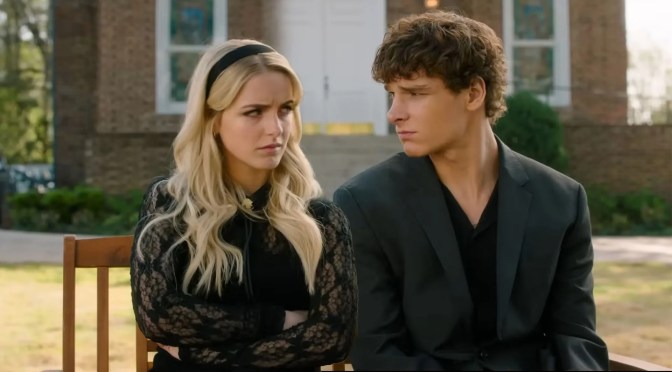
More dynamic would be Clara’s burgeoning relationship with the coolest kid in school, Miller Adams, who is played by How to Train Your Dragon’s Mason Thames. We’re told Miller comes from a family of bad apples but this never really rings true to his catalogue good looks, twee relationship with his grandfather (Clancy Brown) and the random subplot he offers, concerning a long-term ploy to shift the city border a couple of miles. Thames does, at the very least, share a much needed chemistry with Grace and finds YA sparks in the scenes they share. It’s an odd fit to broader themes of grief and betrayal but does at least manage to feel like a plot strand that’s going somewhere a viewer may wish to follow.
There are flushes here of a more entertaining film. Depth is beyond the material but a crippling dinner party sequence squeals with awkward energy, while an earlier car park grounding finds Williams nailing the required comic timing. It’s all very pretty to look at and I’ve no doubt will divert the right crowd but don’t bother with the tissues this time – it’s dry eyes all round.

T.S.
 The Film Blog