
★★★
A year on, it feels legitimate to consider Jon M. Chu’s Wicked: Part One a barnstorming success. Not content with defying gravity at the box office, the film proved popular through the awards season and spawned the cultural moment that was Cynthia Erivo and Ariana Grande’s space-held press tour. Part two, subtitled For Good, dances through on a slightly tougher sell. It’s the stage musical’s less beloved second half, complete with notoriously weaker songs and haphazard attempt to crowbar the original Baum circle into Macguire’s square.
Though filmed concurrently with its predecessor, For Good enjoys a certain tonal separation from the former’s ebullience and showstopper aspirations. Reducing his wider ensemble to a mere handful of lines apiece – some fair better than others – Chu hones more deeply here on the core relationship betwixt his witches, which cannot now help but feel consanguineous with that of Erivo and Grande themselves. The settings, though more diverse than before, feel smaller here, almost reminiscent of the soundstages of 1939. That’s no bad thing. It’s almost nostalgic.
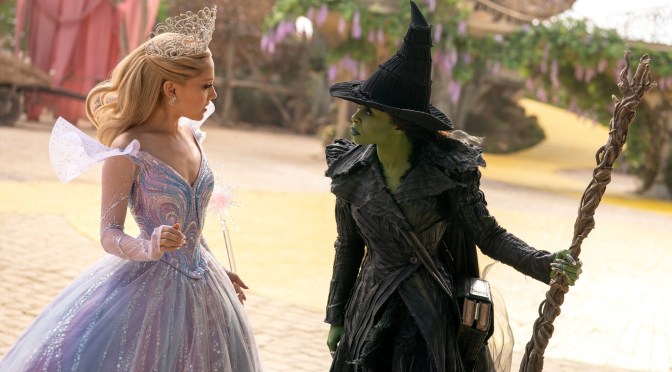
If it’s not entirely clear how long a timeframe separates the two films, the vibes suggest no more than a year. Chu never fully commits to YA dystopia but there’s a tinge of mud in the pink this time around. At the machinations of Jeff Goldblum’s not-so-wonderful Wizard of Oz, and his Machiavellian press secretary – Michelle Yeoh’s Madame Morrible – Elphaba (Erivo) and Glinda (Grande) are now firmly cast die. Eco warrior Elphie is known Oz-wide as the Wicked Witch of the West, with Glinda resolutely “the good”. One wears black from pointy hat to pointy boot, the other raids a lush fancy dress wardrobe to don dresses of increasing lustre and scale from scene to scene. Each ups the camp on Part One tremendously. Much needed as things turn serious…and perhaps a little glum.
Which is not to say that For Good is a film of great narrative depth or, even, substantial progression from where we left things a year ago. At times, most notably in the fleshing out of backstories for the Tin Man and Cowardly Lion, For Good serves more as fan fiction than a revisionist work in its own right. Some of this is fun, some nonsensical. For instance, the politicisation of Oz’s iconic yellow brick road has mileage but the Scarecrow’s brain hunting is never satisfactorily explained.
The decision to feature Dorothy, meanwhile, only as a faceless sequence of disembodied limbs and extremities proves a dud. Silhouette and suggestion is, dramatically, fine on stage but disjoints a film. This is not to suggest that Dorothy’s input is especially successful on Broadway either.
Two new songs soup up the soundtrack, a ballad each for Elphaba and Glinda, penned by original lyricist Stephen Schwartz. Neither breaks new melodic ground, nor resolves the Act One to Two memorability imbalance. And yet, Chu shoots each sequence with admirable bravura, seizing the opportunity for performance-driven storytelling. In No Place Like Home, Erivo explores translatable racial tensions in Oz with a heart and soul that extend far beyond the fourth wall and feel ever so true. Grande’s Girl in the Bubble, by turn, is dainty, elegant and overshadowed by Chu’s artful use of mirror choreography. It’s rather cleverly done.
While Grande remains a fine Glinda – her gift for flinty humour is undeniable but outweighs her capacity to convey emotional depth here – the film belongs to a superior Erivo. Pushed to the very edge, Erivo’s Elphaba thrums with the every beat of the magic flowing through her, offset from total fluidity by her overwhelmingly angsty energy . Erivo is all in with her performance and digs deep for the delivery.
That much of said delivery is achieved while Erivo was wired up and in being thrown around in front of a blue screen – the flying visuals are superb here – is quite extraordinary. Erivo is quite extraordinary. A casting coup that really does change things for the better.
T.S.
 The Film Blog