
★★★★
To weep or not to weep? It’s not so much a question as it is an inevitability in Chloé Zhao’s profoundly moving adaptation of Hamnet. Drawn from the equally affecting novel by Maggie O’Farrell, who takes joint credit for the film’s screenplay with Zhao herself, Hamnet draws woozily on the tragic 1596 death of the only son of William Shakespeare and Anne – here referred to as Agnes – Hathaway. In the sixteenth century, an opening epitaph advises, the names Hamnet and Hamlet were interchangeable. Hamnet’s supposition has Hamlet a tragedie born of truth. There’s no doubting, at least, the film’s emotional honesty in its exploration of the loss.
Much of this is born, of course, of Zhao’s pitch perfect casting. Paul Mescal is Shakespeare himself, all lust, ambition and sorrow, but serves in support of an extraordinary Jessie Buckley, whose Agnes Hathaway ascends from earthly sprite to potent principal though the course of the film. Communicating the grief of her own maternal loss before we even know it is there – never mind the rollercoaster of motherhood that we do know lies ahead of her – Buckley delivers an Agnes of immediate, instinctive full realisation. It’s no wonder the Bard to be finds himself mesmerised at first sight. We all are.
Will is a tutor as we meet him – ‘teaching Latin to boys who will be nought but sheep farmers’ – at work in a terrifically recreated period Stratford. It is as his wards dully recite and repeat old Roman prose that Shakespeare spies Agnes, dressed in earthy red and at one with the wilderness. It is said locally she is the daughter of a forest witch and there’s no doubting the ethereality of her almost pagan herbalism. Agnes at first rebuffs the advances of Will, framed every bit the Prospero to her Ariel, but there’s thrill in the chase. What follows is a whirlwind romance in the court of nature; tender, naturalistic and unabashedly carnal.
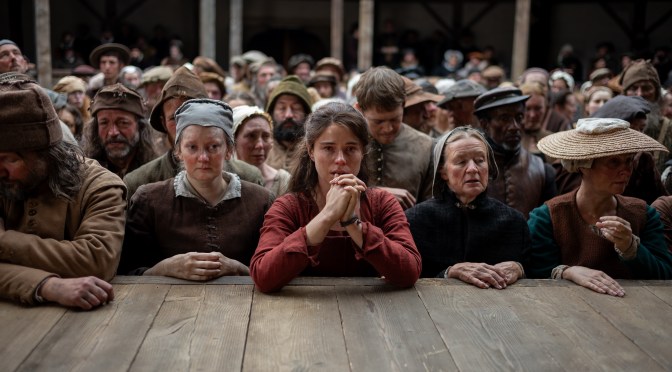
From this woodland dalliance comes the immortal line: ‘the child in her belly, did you put it there?’ Three children follow. The first, Susanna (Bodhi Rae Breathnach) is born in the forest itself and following the most remarkable of labour scenes. Zhao sits her camera on high in a hawk-eye view, and simply waits and watches. Buckley delivers in every sense of the word. It’s mesmeric and entirely typical of Zhao’s approach, which leans rather literally in Hamnet towards that Shakespearean understanding that ‘all the world’s a stage’. Interior scenes feel framed exactly thus. Outdoors, Zhao’s hand is freer but almost documentarian.
After Susanna, come twins Judith (Olivia Lynes) and Hamnet (Jacobi Jupe), a spirited youngster with dreams of following his father to London and the great playhouse. It is no spoiler to note that these dreams go unrealised. When it comes, the sequence of Hamnet’s passing is as core-cutting as you might fear. Buckley’s raw, guttural scream haunts long into the credits, as does the moment mere scenes prior in which Hamnet crawls into his sister’s plague ridden bed, assuring her that he will trick death into taking him instead. It’s a heavily foreboded tragedy – from the lingering of a dark pit in the forest to Agnes’ vision that only two will stand at her own deathbed – but no less startling for it. The rest is silence.
In truth, Zhao is not always so successful in overcoming a labouring of her point. A Thames-side instance, for example, of Shakespeare self-soliloquising a dark ebb stands out for its inauthenticity. And yet, a finale act that threatens to boil well over the pan never does because, for the most part, all within earn the heightened emotional environment.

T.S.
 The Film Blog