
★★★
It’s not fealty that’s bringing the crowds to Emerald Fennell’s “Wuthering Heights,” a film that often feels less like an Emily Brontë adaptation than organic entity in and of its own right. No, these are bathtub sperm and FOMO fuelled walk ups, attracted to Fennell’s unique brand of zeitgeist chic and conservative baiting. To this end, the film starts strong, with heavy breathing giving way to a memorably erotic hanging. The corpse gets an erection and Vicki Pepperdine plays an aroused nun. Mercy, me. Where Fennell’s Heights will fell students of literature, however, there is ample here for those of film to digest. Much dazzles.
As vibes-based cinema, Fennell’s film is less tonally detached from Brontë’s original text that purists might have one believe. Certainly, it feels wholly appropriate, given the accusations of moral depravity levelled at ‘Wuthering Heights’ in 1847, that a contemporary remake might seek to up the ante in pursuit of comparable reception from the modern day viewer. Retained, too, are Brontë’s gothic influences. Gallons of fog are spooled over the Yorkshire moors, upon which much of the action takes place, while fine but deliberate rain is retooled effectively as film grain. Naturally, Fennell cannot help but enhance her own gothic romanticism with an arch excess and eye for the high camp. The approach is as subtle as a brick to the head but delectable nonetheless.
Charlotte Mellington and Owen Cooper – of Adolescence renown – introduce the young Cathy and Heathcliff, the latter rescued from the streets of Liverpool by the former’s comically barbaric father (an excellent Martin Clunes). Feral wildlings each, the pair grow into one another across the windswept moorlands and are soon inseparable. So it remains as, years on, Margot Robbie and Jacob Elordi – each impeccable in their accents – take on the parts. The thrust of all that follows lives and dies on the raw chemistry a petulant Robbie shares with the ruggedly muscular Elordi. Age inconsistency aside, this is pitch perfect casting.
It’s true that Fennell’s script wants for more scenes that outlast a sixty seconds – there can’t be more than a half dozen across the runtime – and the breathing space that such would afford her narrative. This comes to something of a head in a midsection reminiscent of Baz Luhrmann’s Gatsby, complete with its Charli XCX penned soundtrack, but matures into a more tortured final third. The emotional register throughout throbs around the throngs of lust and longing, without ever delving so much further into the soul behind it. There’s ample carnal ferocity, and envy to fuel the fires of Hell itself, but not quite the substance required to find the humanity required.
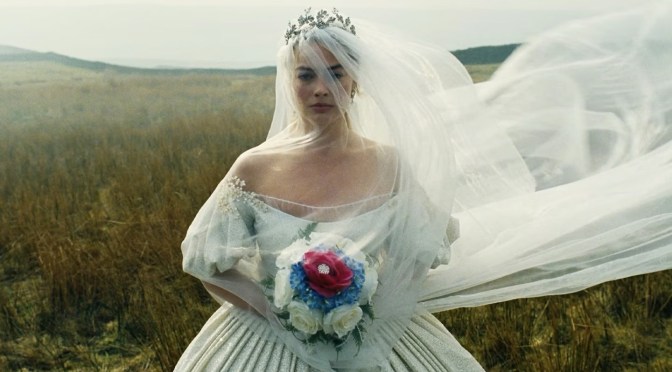
Similar cannot be said of the film’s aesthetic quality, which proves splendid on every level. From the Heights itself, framed within imposing slate rocks, to the cavalcade of fashions afforded Cathy in her Linton era. If her wedding dress offends period norms, its elegant outreach looks no less extraordinary for it, processed as it is across the moss. No opportunity is missed in “Wuthering Heights” for the absolute melodrama of a potent visual to be thoroughly milked. Perhaps the best is the transition from an overhead shot of a grief stricken Cathy, a mass of blood red chiffon on a chessboard floor, to that of Heathcliff on horseback, framed against a raging umber sky.
Even without the book’s latter half, and Brontë’s denser plotting therein, Fennell’s film begins to feel long as the finale nears. There’s only so much synthy scoring and rampant adultery anyone can take and Fennell hasn’t a naked Barry Keoghan in her back pocket to take this one across the finish. Instead, a flashback: ‘I’ll love you ’til the day I die, and after’. The extent of your heartbreak will depend on your buy-in to his and whether Fennell’s gorgeous widescreen has breadth enough for the minutiae within it.

T.S.
 The Film Blog