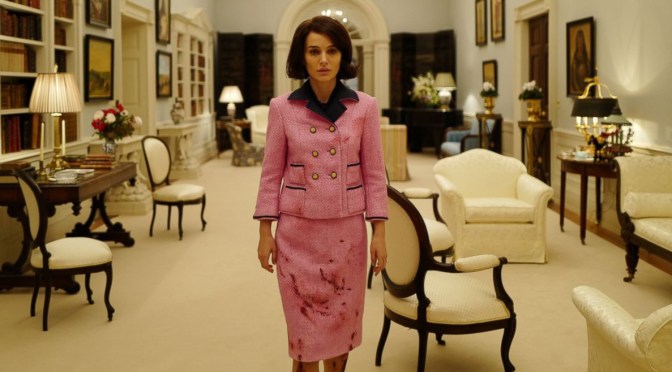
In political boundaries, legacy is everything. As Donald Trump quite assiduously begins to dismantle that of Barack Obama in America, it’s a timely film that examines how it can be that those left behind may make or break the legend. This is the mantle taken by Chilean director Pablo Larraín in his first English-language film.
We swan around in our privileged lives and it makes me sick.
80,000 children go missing in India every year. Read that sentence again. It’s a harrowing truth and deeply upsetting. It’s also the opening message and concluding statement of Garth Davis’ cinematic debut Lion, a profoundly moving film taken from the true story of a boy separated from his family by terrible misfortune. Lion begins with five year old Saroo (Sunny Pawar) and his elder brother, Guddu (Abhishek Bharate), stealing and selling from a coal train to support the rest of their impoverished family. Chaotic camerawork, so common in filmmaking’s approach to the fast and overpopulated Indian metropolis, follows the pair as they buy milk for their troubles and return victors of the ‘hunt’. Things go awry when Guddu leaves an exhausted Saroo on a station platform during a night job but does not return. Saroo’s journey as it unfolds hereafter takes the story thousands of miles and results in his adoption and emigration to Australia to live with John and Sue (David Wenham and a masterful Nicole Kidman). It is a jump of twenty years into the future and the sensory awakening provided by an Indian treat from his childhood that inspires in Saroo (now Dev Patel) an emotionally destructive obsession with rediscovering his home.
Entering T2:Trainspotting, the twenty-years later sequel to Danny Boyle’s Trainspotting, a quote from the latter comes to mind. Not the ‘choose life’ one – which, anyone who’s seen the trailer will already know, gets an updated reprise in T2 (‘choose Facebook’). No, it was Diane’s ‘You’re not getting any younger’ speech: ‘The world’s changing; music’s changing; even drugs are changing…you’ve got to find something new’. Back in 1996 Trainspotting was newness epitomised. Is it unfair to want the same of the follow up? How can a sequel ever be as original as, well…the original?



 The Film Blog