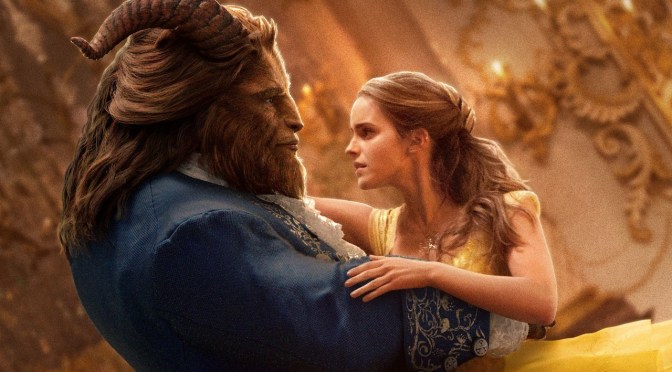
The enduring success of Disney’s 1991 Beauty and the Beast is such that the film does not solely remain one of the greatest animated features of all time but among the greatest of any medium. The first Disney musical to be translated to Broadway, it is a well quoted fact that Beauty and the Beast was also the first animation ever to gain a – much deserved – Best Picture nomination at the Oscars. Thus, at a time in which the House of Mouse seems intent on remaking their entire back catalogue, a live action update of this particular classic was surely inevitable, if unnecessary.
There’s a pivotal scene in Douglas Sirk’s All That Heaven Allows in which the reflected image of Jane Wyman’s Cary is framed within a television screen, bought for her by her family. Its a symbolically charged moment, the film revolving around the socially ‘scandalous’ relationship of an affluent widow and her younger gardener, dictating that a woman of Cary’s age and marital status must be prisoner to a life ruled by consumerism and the home. Sixty-seven years later, Anna Biller appropriates the image in The Love Witch, maintaining Sirk’s glorious technicolor, in her use of a mirror as the captive frame not of the woman, who moves freely in and out, but of the man, who is slavishly trapped in his bed. Whilst perfectly capturing the aesthetics of mid-twentieth century Hollywood, Biller’s film is a subversive, and deliciously addictive, feminist hit.
Heritage Cinema is too easy to sniff at. Likewise, populist historicals are too often the recipient of critical derision. Indeed, much of my own criticism for Theodore Melfi’s recent Hidden Figures was perhaps even guilty of this. Broad strokes in cinema can grant a complex issue vital accessibility, a fact that should absolutely be celebrated. That said, it’s a fine balance and I maintain – for now anyway – that Hidden Figures takes simplification just too far in its crowd pleasing to fully enable a more than surface-level depth.