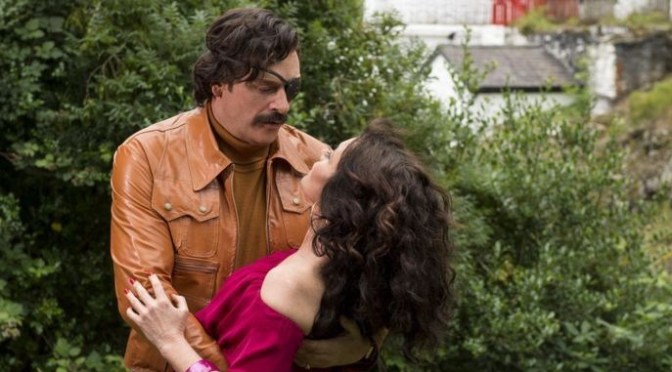
Enter Mindhorn blind and you might be surprised at just how starry the, Sean Foley directed, production’s cast list is. Without giving away the full roster (including one particularly rib-tickling cameo), Andrea Riseborough – so powerful in Channel 4’s National Treasure – holds a prime billing here, as does Steve Coogan – whose production company, Baby Cow, has associate credits too. From The Mighty Boosh, meanwhile, Julian Barratt takes the lead role of Richard Thorncroft, the washed-up former star of hit eighties, Isle of Man cop-drama: ‘Mindhorn’. Thorncroft’s career, once so promising as to boast merchandise, has hit the rocks since then and his agent (Harriet Walter) has all but given up of him. This is, of course, predominantly due to Thorncroft’s penchant for offending both his co-stars and the entire population of the Isle of Man alike. An infamous interview having proved particularly damning: ‘We’ve never forgotten what you said about us on Wogan’. The epitome of his fall from grace is that he now even suffers from the indignity of having been replaced by John Nettles in adverts for thrombosis socks. To add insult to injury, Thorncroft’s lost weight in his hair and found it in his waist.
In many ways, Guardians of the Galaxy Vol. 2 feels like the superhero film that its director, James Gunn, always wanted to make. Back in 2014, the first in this soon-to-be-trilogy was widely regarded as a bit of a risk for Marvel, its titular protagonists being a lesser known team of heroes than the Avengers. It did, however – aiming squarely for a joie-de-vive tone and a whole galaxy of mainstream fun – prove to be a rip roaring success. Such features are largely carried over into Vol. 2 (does this mean Guardians of the Galaxy is retrospectively Vol.1 now?), yet, with a soundtrack drawn more deeply from the nostalgia catalogue than the recognisable hits that peppered the former and a focus on character development over heightened stakes, Gunn’s is a more prominent and untethered directorial hand this time around.
It’s surprising just how unnerving it feels to be watching Jim Broadbent in a – relatively – sedate role. Usually the embodiment of joviality in his work, The Sense of an Ending sees Broadbent unveil a performance which is painstakingly controlled, and fastidiously measured to the point of nuance. Not that this unexpected from the award winning star of Iris and Moulin Rouge, but it is certainly a welcome shift in tone from an actor normally typecast as beaming, booming and bumbling.



 The Film Blog